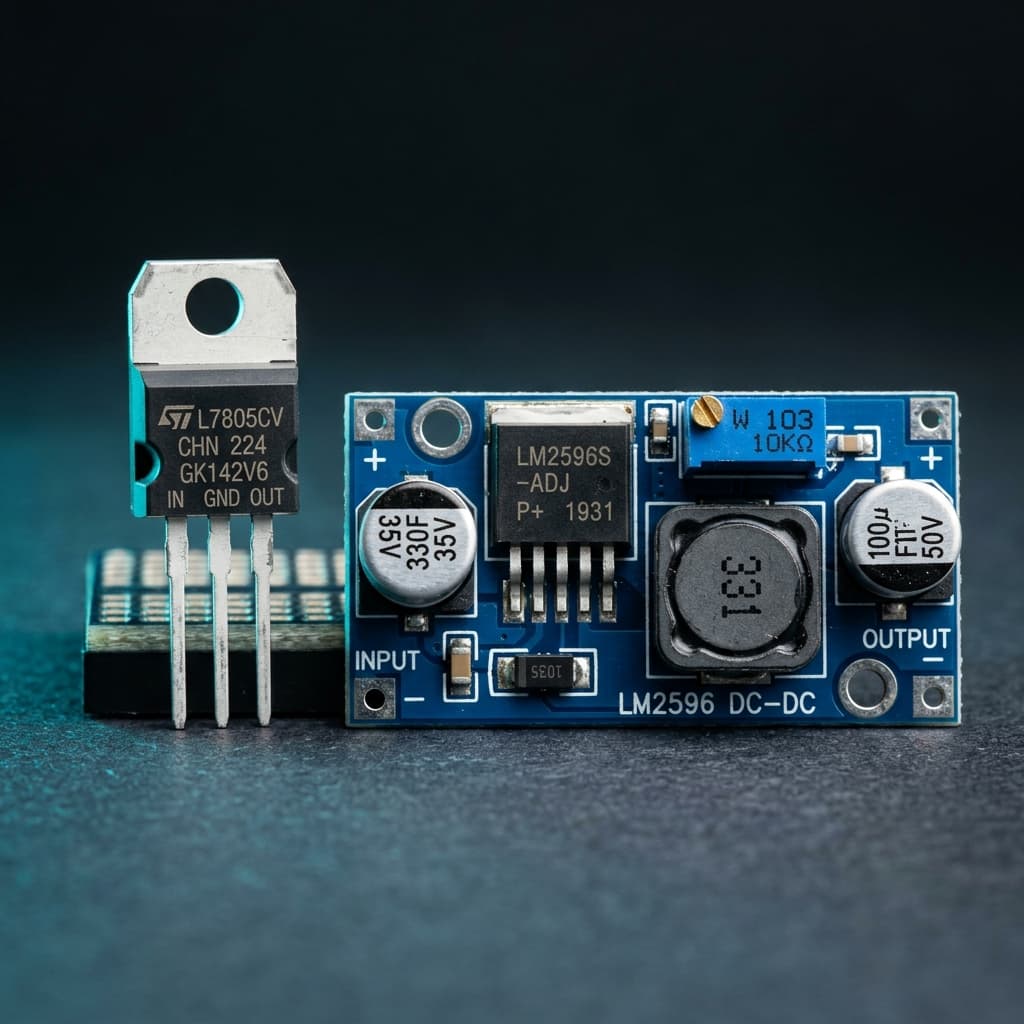
What Is a Voltage Regulator?
Without voltage regulation, every circuit would need to handle a wide range of supply voltages. A 9V battery that discharges to 6V would change the behavior of every connected component. A regulator acts as an intelligent buffer — absorbing variations in Vin and delivering a rock-steady Vout.
Linear Regulators: Simple but Wasteful
A linear regulator places a voltage-controlled transistor (series pass element) in series with the power path. A feedback circuit compares the output to an internal reference and adjusts the transistor to maintain constant Vout. The fundamental trade-off: the transistor drops the excess voltage, dissipating it entirely as heat.
Power dissipated = (Vin − Vout) × Iload
Efficiency = (Vout × Iload) / (Vin × Iload) = Vout/Vin
Example: L7805 (Vin=12V, Vout=5V, Iload=500mA) dissipates (12−5) × 0.5 = 3.5W as heat. Efficiency = 5/12 = 41.7%.
L7805 Standard Wiring
L7805 Pinout (TO-220 package, facing label):
  Pin 1 (LEFT)   = INPUT  (+7V to +35V)
  Pin 2 (MIDDLE) = GND    (Common ground)
  Pin 3 (RIGHT)  = OUTPUT (+5V regulated)

Required capacitors (from datasheet):
  0.33µF ceramic from INPUT to GND (close to IC)
  0.1µF ceramic from OUTPUT to GND (close to IC)

Optional: 100µF electrolytic at output for stability
Buck Converters: Efficient Switching Regulation
A buck (step-down) switching converter operates by rapidly switching a MOSFET ON and OFF (at 100kHz–2MHz), using an inductor and capacitor to average the pulsed output into a smooth DC voltage. The duty cycle D = Vout/Vin controls the output:
Vout = Vin × D     (where D = TON / TPERIOD)
Efficiency ≈ 85–98% (most loss in MOSFET switching)
| Property | Linear (L7805) | Buck (LM2596) |
|---|---|---|
| Efficiency | 41% (12→5V) | 92% (12→5V) |
| Heat Generated | 3.5W at 500mA | 0.24W at 500mA |
| Output Noise | Very Low (~µV) | Higher (mV ripple) |
| Component Count | 3 (IC + 2 caps) | 6 (IC, L, D, 3 caps) |
| Cost | $0.20 | $0.80–2.00 |
| Best For | Low noise, low current | High current, battery life |
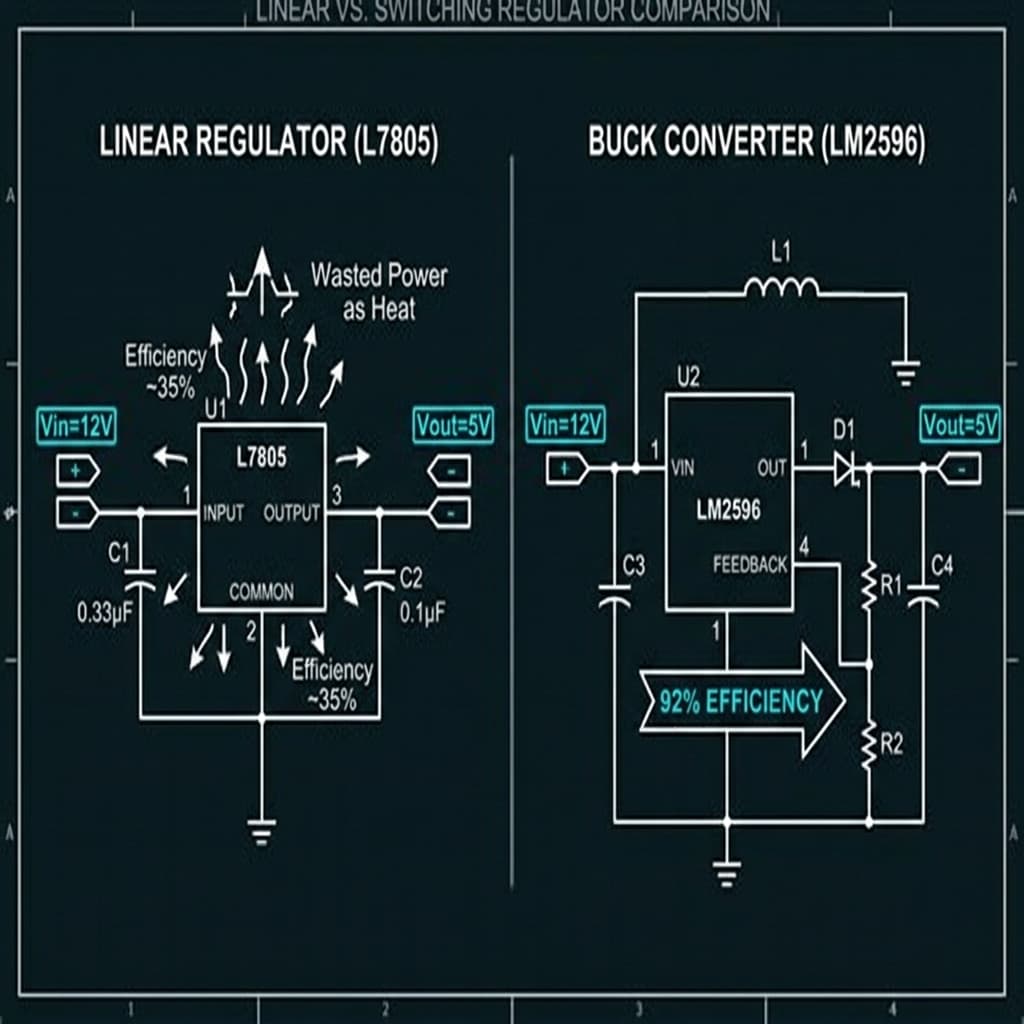
Fig 1: Circuit Comparison — Linear LDO (pass transistor voltage drop) vs. Switching Buck Converter (switch + LC filter)
Frequently Asked Questions
What is a voltage regulator and what does it do?
A voltage regulator maintains a constant output voltage regardless of input voltage variations or load current changes. For example, an L7805 always outputs 5V whether powered by 7V or 12V, delivering stable power to microcontrollers and sensors.
What is the difference between a linear regulator and a buck converter?
Linear regulators dissipate excess power as heat (Vout/Vin efficiency). Buck converters switch a transistor rapidly using an inductor to transfer energy efficiently (85-98%). Use linear for low-noise/low-current; use buck for high-current or large Vin−Vout differences.
What is dropout voltage in an LDO regulator?
Dropout voltage is the minimum Vin−Vout difference needed for regulation. Standard L7805 needs 2V dropout (Vin must be ≥7V). True LDO regulators have as little as 0.1V dropout, critical for near-dead battery operation.
Do I need a heat sink for an L7805?
Yes, for significant loads. A 7805 from 12V at 500mA dissipates 3.5W. Without a heatsink, the thermal resistance causes overtemperature shutdown or destruction. Add a heatsink for loads above ~100mA with large voltage drops.
When should I choose a linear regulator over a buck converter?
Use a linear regulator for: low current (<100mA), small Vin−Vout difference, ultra-low noise (ADC references, audio), or simplicity. Use a buck converter for: high current, large voltage drop, battery-powered applications, or thermal concerns.
📚 References & Sources
Related Resources
How Power Supplies Work
Full AC-DC power supply design with transformers and rectifiers.
How Inductors Work
The inductor is the key energy storage component inside buck converters.
How Capacitors Work
Output filter capacitors are essential for smooth regulator output.
How Transistors Work
The MOSFET switch that makes switching converters possible.