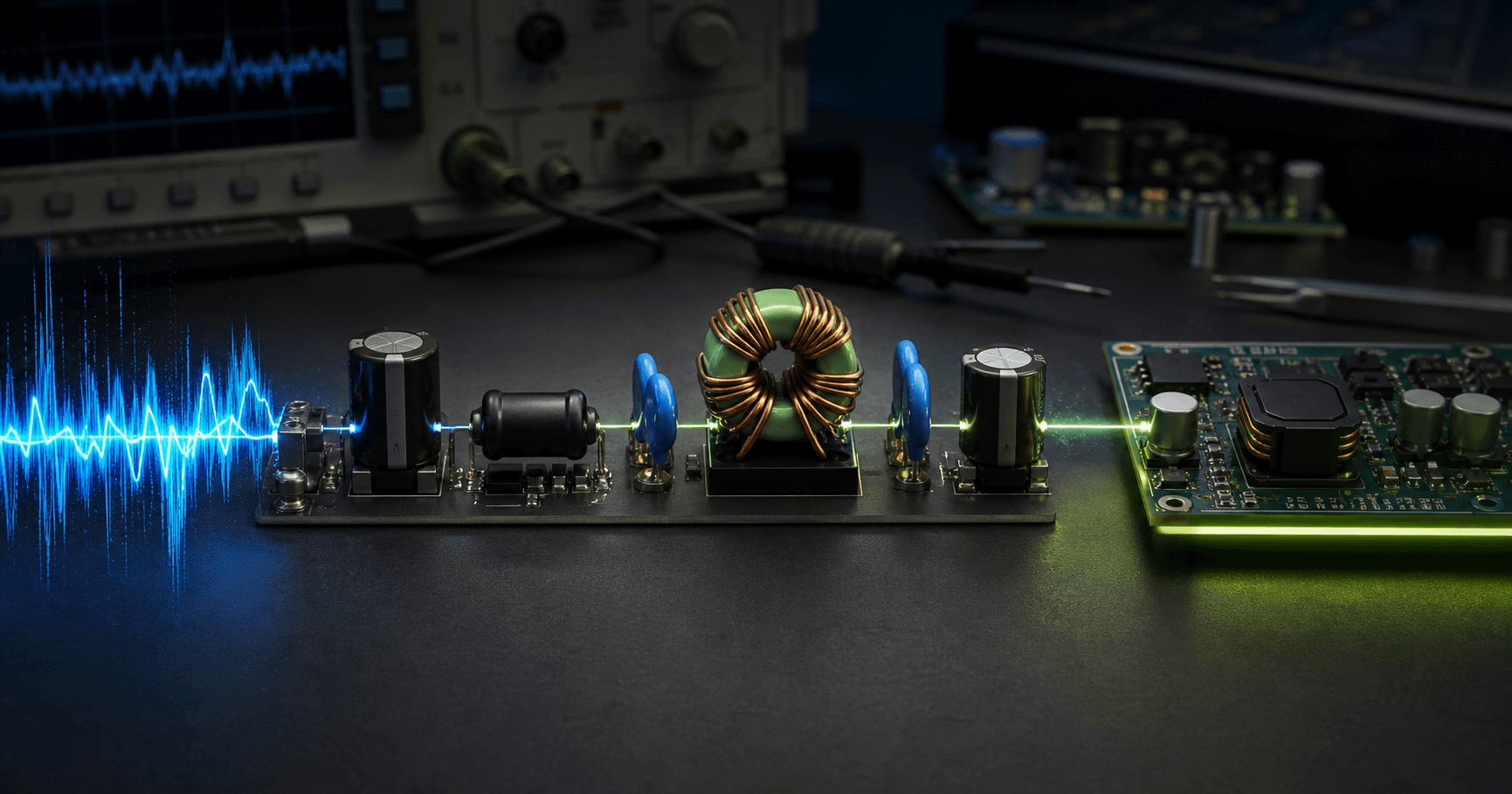
How EMI Filters Work: Direct Definition
- [How EMI Filters Work] [connects] [circuit theory to practical wiring]
- [how EMI filters work] [improves] [debugging accuracy and component selection]
- [Volt X guides] [link] [related tools, sensors, and embedded systems]
What EMI Filtering Is Trying to Stop
Electromagnetic interference is unwanted electrical energy that escapes from one part of a system and disturbs another. Switching converters, motor drivers, long cables, relays, and fast digital edges can all inject noise. EMI filters provide high impedance to noise frequencies or a low-impedance return path that keeps noise local.
Differential Mode vs Common Mode Noise
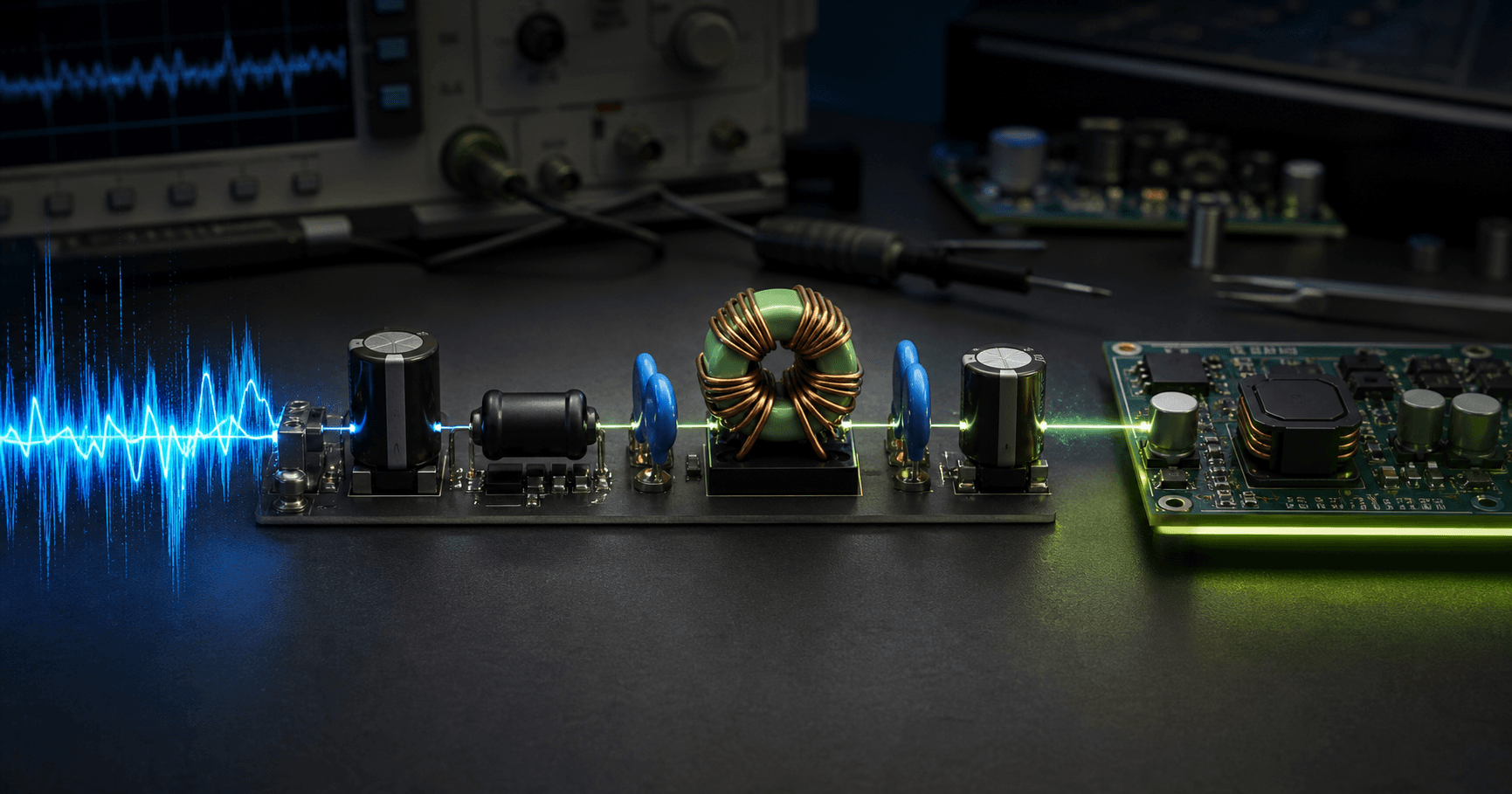
Differential noise flows out on one conductor and returns on another. Capacitors across the line and series inductance help control it. Common mode noise flows in the same direction on multiple conductors and returns through stray capacitance or chassis paths. Common-mode chokes and Y capacitors are used to reduce it.
Ferrite Beads and Decoupling Capacitors
A ferrite bead acts like a frequency-dependent resistor for high-frequency noise while passing DC current. A decoupling capacitor gives fast current spikes a nearby local loop. Together, they can isolate a sensitive analog or RF supply from a noisy digital or switching supply.
Layout Matters More Than Parts Alone
A perfect filter placed badly will disappoint. Keep high di/dt loops small, place capacitors close to the pins they protect, avoid routing noisy switch nodes under sensitive traces, and give return currents a clean path. EMI control is part schematic and part geometry.
Parts and Modules Availability in India
For student labs and prototype builds in India, look for the exact voltage rating, interface level, package type, and module quality before buying. SP Road in Bangalore, Lamington Road in Mumbai, Lajpat Rai Market in Delhi, Ritchie Street in Chennai, Koti in Hyderabad, Budhwar Peth in Pune, and Chandni Chowk Market in Kolkata commonly stock beginner-friendly modules and passives.
Frequently Asked Questions
What does an EMI filter do?
An EMI filter reduces unwanted high-frequency noise on power or signal lines. It works by blocking noise current, shunting noise to a local return path, or both.
Why do EMI filters matter in electronics?
It matters because small interface decisions can change accuracy, reliability, safety, and debugging time. Understanding the fundamentals helps you choose values, modules, and wiring methods intentionally.
What is the most common EMI filtering mistake?
The most common mistake is treating the circuit as ideal. Real components have limits such as input impedance, noise, timing, voltage ratings, heating, drift, or contact behavior.
Can beginners use this in Arduino projects?
Yes. Start with a low-voltage breadboard setup, verify ratings, use conservative resistor values or modules, and test one signal at a time before connecting expensive boards or high-power loads.
Conclusion
How EMI Filters Work becomes much easier when you separate the ideal idea from the physical limits. Use the specs above, test with conservative values, and connect this topic with related Volt X guides before scaling a prototype into a finished build.