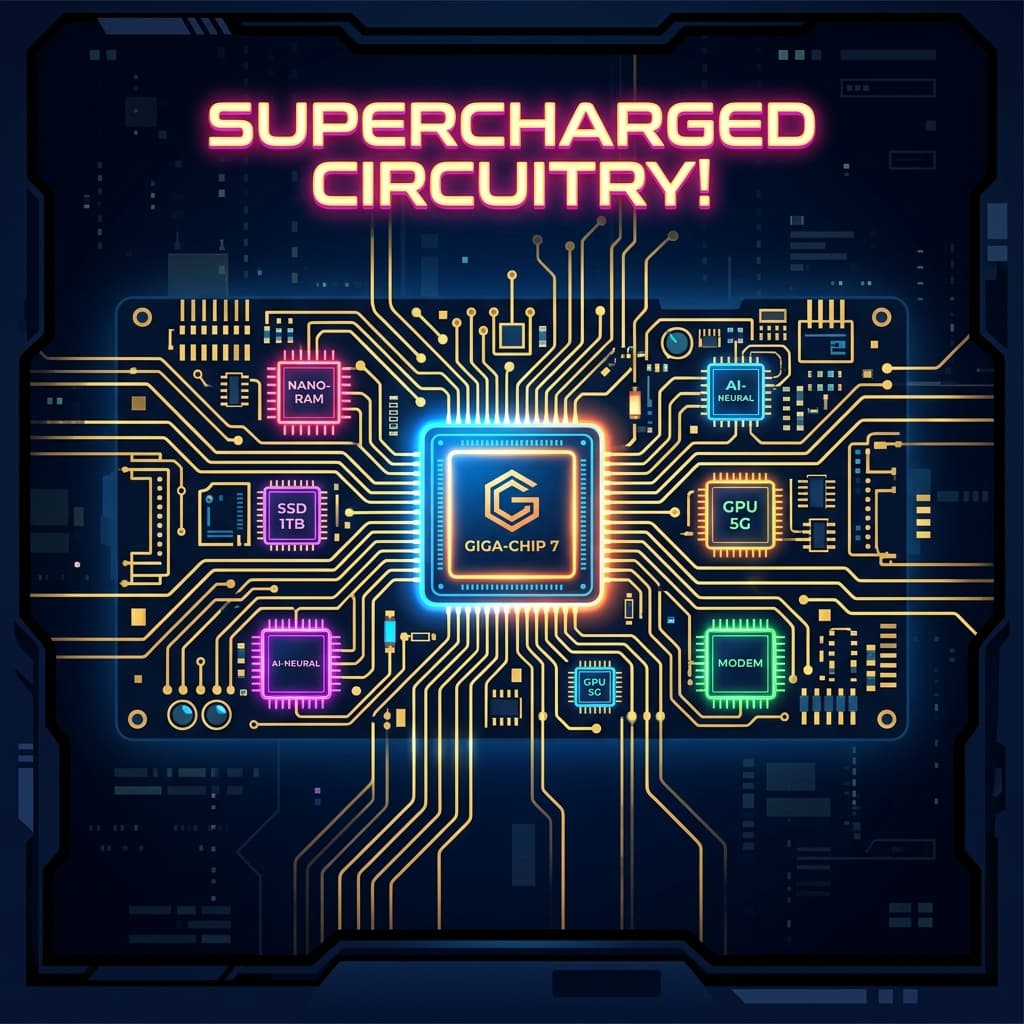
Have you ever wondered what lives beneath the glass and metal of your pocket computer? A smartphone motherboard (or logic board) is arguably the most densely packed piece of consumer electronics ever engineered.
Unlike a desktop PC where components plug into large slots, a smartphone integrates gigabytes of RAM, an 8-core processor, a 5G modem, and advanced power management into a space smaller than a credit card. Let's peel back the EMI shielding and explore the microscopic components that make up a smartphone motherboard.
The SoC: System on a Chip
In a desktop computer, the CPU, GPU, and memory controllers are separate chips. In a smartphone, there isn't enough space for that. Instead, manufacturers use an SoC (System on a Chip).
The SoC—such as Apple's A-series or Qualcomm's Snapdragon—contains the Central Processing Unit (CPU), Graphics Processing Unit (GPU), Neural Processing Unit (NPU) for AI tasks, and the Image Signal Processor (ISP) that handles your camera data.
The PMIC: Power Management IC
A smartphone battery outputs a single voltage, usually around 3.8V. However, the SoC might need 1.1V, the camera might need 2.8V, and the display might need 5V.
This is where the PMIC comes in. It is basically the heart of the power distribution network, stepping voltages up or down with incredible efficiency. Surrounding the PMIC, you will see a cluster of tiny grey blocks (inductors) and brown rectangles (capacitors) that help filter and stabilize the power before it reaches sensitive microchips.
Baseband Processor and RF Transceivers
Your smartphone is, fundamentally, a radio. The Baseband Processor (modem) handles the incredibly complex math required to encode and decode 5G and LTE signals.
Nearby, the RF (Radio Frequency) Transceivers and Power Amplifiers boost the signal so it can reach a cell tower miles away. Because these components handle high-frequency radio waves, they are extremely sensitive to interference and are usually covered by shiny metal EMI (Electromagnetic Interference) shields.
Frequently Asked Questions
What is an SoC on a smartphone motherboard?
An SoC (System on a Chip) is the brain of the phone. It combines the CPU, GPU, Neural Processing Unit (NPU), Image Signal Processor (ISP), and sometimes the modem into a single piece of silicon to save space and power.
What does the PMIC do?
The Power Management IC (PMIC) is responsible for taking the 3.7V to 4.2V from the battery and converting it into the dozen different voltages required by the various components on the motherboard.
Can you upgrade the RAM on a smartphone motherboard?
No. Smartphone RAM is soldered directly to the motherboard, and in many high-end devices, the RAM chip is actually stacked directly on top of the SoC (Package-on-Package) to save space and reduce latency.
What is the baseband processor?
The baseband processor (or modem) handles all cellular communication. It encodes and decodes the complex radio frequencies (5G, LTE) into digital data the SoC can understand.
Conclusion
Smartphone motherboards are a masterclass in electrical engineering and miniaturization. The next time you hold your phone, remember the tiny city of microchips, filters, and amplifiers humming away inside.