Touch Sensor (TTP223)
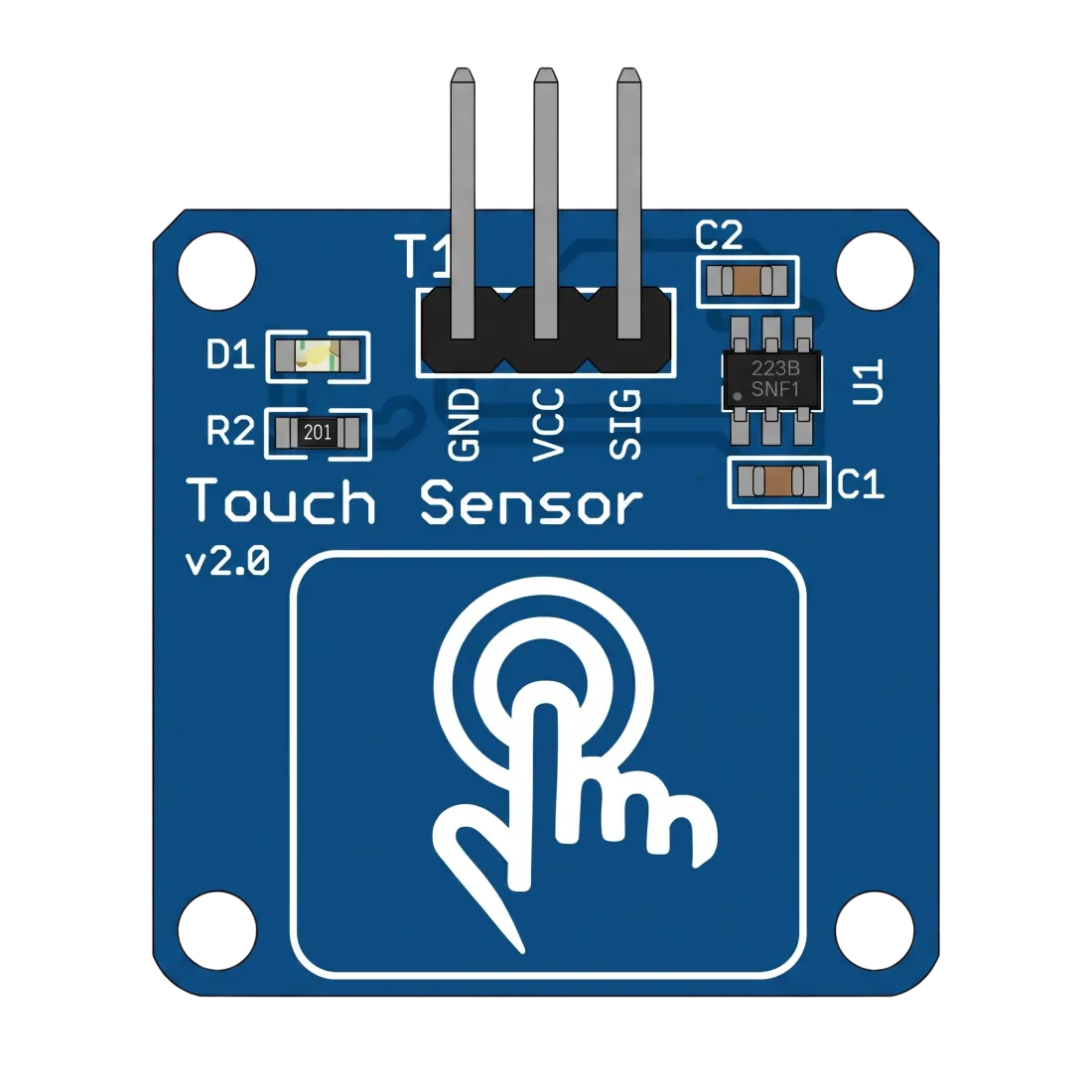
What is TTP223?
The TTP223 is a capacitive touch sensor detector IC that acts as a modern, durable alternative to traditional mechanical buttons and switches. It is designed to sense the proximity of a human finger.
Operating at a low power state and adjusting quickly to background environments, the TTP223 registers changes in electrical capacitance. Once a touch is detected, it outputs a clean, bounce-free digital HIGH or LOW signal.
Key Features
Capacitive Sensing
Detects human touch reliably through changes in capacitance, eliminating mechanical wear and tear.
Through-Material Sensing
Can detect touch through thin layers of non-metallic materials like glass, acrylic, plastic, or wood.
Configurable Modes
Solder bridges (A & B pads) customize active state (high/low) and output behavior (latch/momentary).
Low Power Mode
Operates at micro-amps in low power mode, perfect for battery-operated devices.
Rapid Response
Quick response time of ~60ms ensures instantaneous touch feedback.
Direct Logic Level
Outputs standard digital signals compatible with 3.3V and 5V logic inputs.
Pin Configuration
VCC
2V - 5.5V Power Supply. Connect to the 3.3V or 5V rail of your microcontroller.
I/O
Digital Output. Outputs HIGH by default on touch detection. Configurable via solder pads.
GND
Ground Connection. Connect to the common ground reference of your board.
How It Works
The Science Behind It
The TTP223 works on the principle of Capacitive Sensing. The sensor pad and a human finger act as the two plates of a capacitor, with air as the dielectric. When a finger approaches or touches the pad, the capacitance increases significantly.
The onboard IC continuously monitors this capacitance. When the change exceeds a calibrated threshold, it triggers a digital output (HIGH). The human body acts as a conductor because of its water content and ionic composition.
Capacitance Equation:
C = ε0 × εr × (A / d)

Touch → d decreases → C increases → Output HIGH (Active State)
Wiring Tips & Best Practices
Decoupling Capacitor
Place a 0.1μF decoupling capacitor close to the sensor's VCC and GND pins to filter electrical noise and prevent false triggers.
Contact Area
Keep the sensing area clean. Dirt, grease, or moisture on the surface can change capacitance and cause false touch events.
GPIO Pulldowns
Configure the microcontroller input pin as INPUT (no internal pull-up/pull-down needed, as the TTP223 actively drives the output).
Mounting Depth
If mounting behind a panel, ensure the thickness of the material (glass/plastic) does not exceed 3mm to maintain sensitivity.
Momentary vs Latching
Bridge solder pad B to toggle latching mode (press once for ON, press again for OFF) instead of momentary mode.
Active-Low Config
Bridge solder pad A to invert the output to active-LOW (outputs LOW on touch, HIGH when idle).