Pressure Sensor
Complete engineering manual covering physical operating principles, pinout architecture, circuit schematics, non-blocking Arduino/ESP32 code, and troubleshooting.
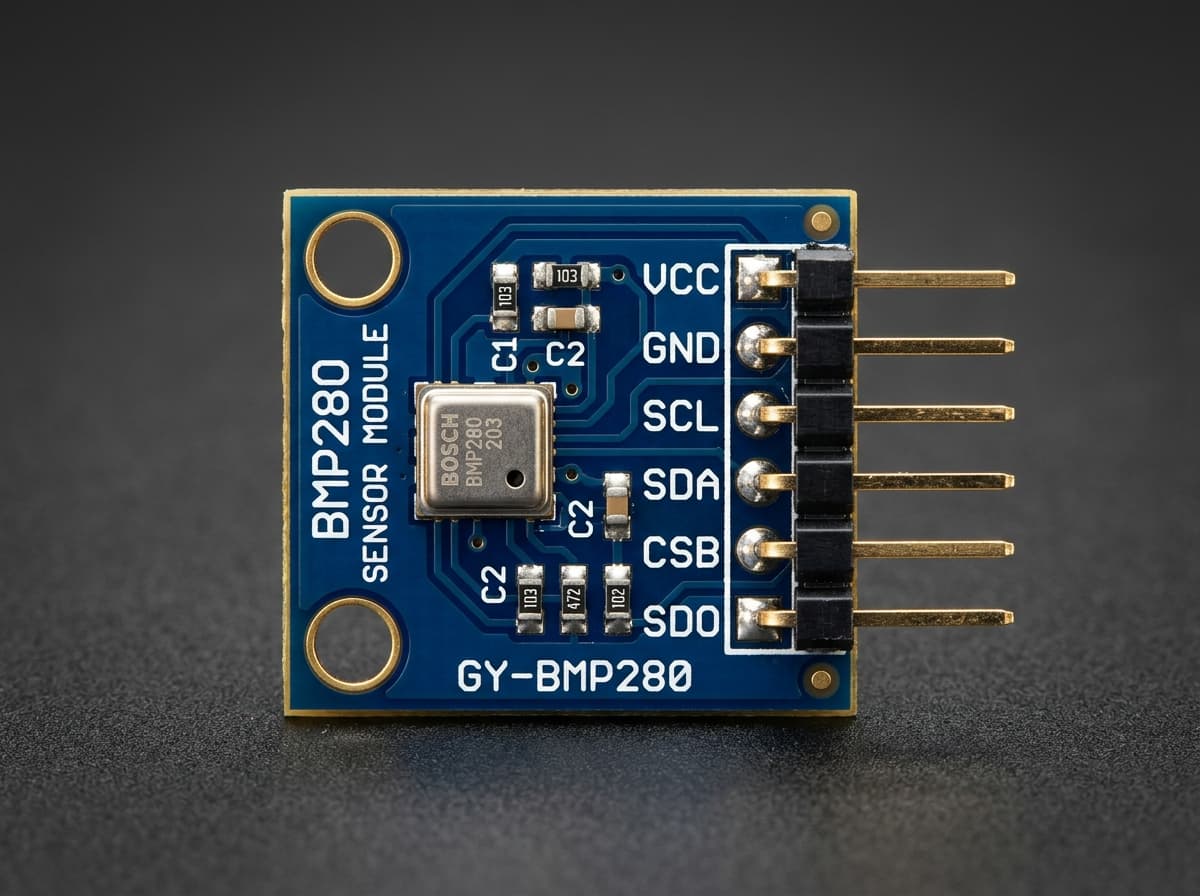
What is a BMP280/BME280 Sensor?
BMP280 and BME280 modules measure barometric pressure for weather stations, altitude estimation, drones, IoT dashboards, and environmental logging. They are widely searched because they combine useful data with simple I2C wiring.
BMP280 measures pressure and temperature. BME280 adds humidity, making it a stronger choice for complete weather projects when the small price difference is acceptable.
Key Technical Specifications
Weather Station Core
Tracks pressure trends that help infer changing weather conditions.
Altitude Estimation
Converts pressure changes into approximate altitude for drones and portable instruments.
I2C or SPI Interface
Most breakout boards work over I2C with only SDA and SCL pins.
High Resolution
Sensitive enough to observe small pressure changes when configured correctly.
Low Power
Works well in battery weather nodes and ESP32 deep-sleep logging projects.
Temperature Compensation
Includes temperature data used internally to improve pressure readings.
Components Required
| Component | Quantity | Engineering Purpose |
|---|---|---|
| Pressure Module | 1x | Primary physical environmental sensing module |
| Arduino Uno R3 or ESP32 DevKit | 1x | Microcontroller for ADC sampling and digital processing |
| Solderless Breadboard (830 tie-points) | 1x | Prototyping circuit layout and common power rail distribution |
| Jumper Wires (Male-to-Male, Male-to-Female) | 6x | Interconnecting microcontroller GPIO, power, and ground |
| Decoupling Capacitor (100nF Ceramic) | 1x | Filtering power rail high-frequency switching transient noise |
| Pull-up / Current Limiting Resistor (10kΩ / 220Ω) | 1x | Level conditioning and bus stability |
Pin Configuration & Connection Diagram
VIN / VCC
Power input. Many breakouts accept 3.3V and some accept 5V through a regulator. Check your board.
GND
Ground reference shared with the microcontroller.
SDA
I2C data line. Connect to Arduino A4 on Uno or the configured SDA pin on ESP32.
SCL
I2C clock line. Connect to Arduino A5 on Uno or the configured SCL pin on ESP32.
CSB / SDO
Optional address or SPI pins on some modules. Leave in default I2C configuration unless needed.
| Sensor Pin | Arduino Uno | ESP32 Node | Signal Description |
|---|---|---|---|
| VCC | 5V (or 3.3V per model) | 3.3V or VIN (5V) | Positive DC supply line. Maintain within datasheet voltage envelope. |
| GND | GND | GND | Common ground reference. Connect all subsystem grounds together. |
| OUT / SIG / DO | D2 (Interrupt-capable) | GPIO 4 | Digital threshold trigger or analog output level. |
| AO (Analog Out) | A0 | GPIO 34 (ADC1 input-only) | Continuous proportional voltage level representing measured physical phenomenon. |
Electrical Best Practices & Noise Mitigation:
- When wiring the Pressure, ensure power leads are kept short to minimize stray loop inductance and inductive bounce during rapid current draw changes.
- If using an analog sensor output with a 3.3V microcontroller like an ESP32 or STM32, verify the maximum sensor output does not exceed 3.3V. If operating from a 5V supply, insert a 2:1 resistive voltage divider (e.g. 2kΩ / 1kΩ) on the signal line.
- Place a 100nF ceramic capacitor across the sensor VCC and GND pins as close to the module package as physically possible to shunt high-frequency ripple generated by nearby motors, servos, or Wi-Fi transients.
Working Principle & Mathematical Modeling
The Science Behind It
A MEMS pressure sensor contains a tiny diaphragm that flexes as air pressure changes. On-chip circuitry measures that mechanical change and converts it into a digital pressure value.
Altitude estimation uses the fact that air pressure decreases as elevation increases. Weather changes also affect pressure, so absolute altitude needs local sea-level pressure calibration.
Altitude Estimate:
Pressure trend down = possible rising altitude or weather shift
Altitude m ≈ 44330 x (1 - (P / P0)^0.1903)
P0 = local sea-level pressure reference
Note: For weather stations, pressure trend is often more useful than a single raw pressure number.
Arduino & ESP32 Implementation Code
// Production-Grade Interface for Pressure
// Platform: Arduino / ESP32 (volt-X Reference Implementation)

const int SENSOR_PIN = A0;       // Analog input pin
const int DIGITAL_PIN = 2;       // Digital threshold pin
const unsigned long SAMPLE_INTERVAL_MS = 250; // Non-blocking sampling rate

unsigned long lastSampleTime = 0;
const int FILTER_SAMPLES = 8;
int sampleBuffer[FILTER_SAMPLES];
int sampleIndex = 0;

void setup() {
  Serial.begin(115200);
  while (!Serial && millis() < 3000); // Allow USB CDC enumeration

  pinMode(DIGITAL_PIN, INPUT_PULLUP);
  analogReadResolution(10); // Standard 10-bit ADC (1024 counts)

  Serial.println(F("========================================"));
  Serial.println(F("Pressure System Initialized"));
  Serial.println(F("volt-X Engineering Lab Reference"));
  Serial.println(F("========================================"));
}

// Moving average filter to suppress high-frequency electrical noise
int getFilteredReading(int rawValue) {
  sampleBuffer[sampleIndex] = rawValue;
  sampleIndex = (sampleIndex + 1) % FILTER_SAMPLES;

  long sum = 0;
  for (int i = 0; i < FILTER_SAMPLES; i++) {
    sum += sampleBuffer[i];
  }
  return sum / FILTER_SAMPLES;
}

void loop() {
  unsigned long currentMillis = millis();

  // Non-blocking telemetry loop without delay()
  if (currentMillis - lastSampleTime >= SAMPLE_INTERVAL_MS) {
    lastSampleTime = currentMillis;

    int rawAnalog = analogRead(SENSOR_PIN);
    int filteredAnalog = getFilteredReading(rawAnalog);
    bool digitalTrigger = digitalRead(DIGITAL_PIN);

    // Proportional voltage calculation: V = (ADC / ADC_MAX) * VREF
    float voltage = (filteredAnalog / 1023.0f) * 5.0f;

    Serial.print(F("Raw: "));
    Serial.print(rawAnalog);
    Serial.print(F(" | Filtered: "));
    Serial.print(filteredAnalog);
    Serial.print(F(" | Voltage: "));
    Serial.print(voltage, 3);
    Serial.print(F("V | Threshold State: "));
    Serial.println(digitalTrigger ? F("HIGH") : F("LOW"));
  }

  // Other robotics / telemetry tasks execute concurrently
}
Code Architecture Breakdown:
- Non-Blocking Execution Architecture: The sketch uses millis() time differentials rather than delay(). This preserves CPU availability for concurrent robotics PID loops, wireless telemetry, or OLED display rendering.
- Circular Moving Average Filter: An 8-sample circular buffer smooths analog jitter caused by thermal fluctuation, electrical EMI, or power rail bounce.
- Calibrated Voltage Conversion: Converts raw 10-bit integer discrete steps into true voltage levels using floating-point proportional scaling.
- Dual Digital & Analog Validation: Reads both continuous analog intensity and the digital comparator output for fault detection and threshold verification.
Real-World Engineering Applications
Automated Industrial Monitoring
Continuous environmental telemetry with threshold alarm triggers and SCADA interface integration.
Autonomous Robotics Navigation
Obstacle avoidance, path finding, and adaptive real-time closed-loop decision making on mobile chassis.
Smart Agriculture & IoT Automation
Battery-efficient sensor nodes transmitting environmental data to MQTT brokers and cloud dashboards.
Safety Interlocks & Security
Fail-safe threshold detection triggering relays, buzzers, and automated machine shutdown protocols.
✅ Engineering Advantages
- Cost-effective and widely available standardized pinout compatible with all microcontrollers.
- Low quiescent current consumption suitable for solar or battery-backed embedded systems.
- Straightforward analog voltage and digital comparator outputs require minimal processor overhead.
- High sampling frequency enables fast transient detection in real-time control applications.
⚠️ Physical Constraints & Limitations
- Analog readings require ADC calibration to account for microcontroller reference voltage drift.
- Environmental factors such as ambient temperature, dust, and humidity can introduce offset errors.
- Unshielded cabling over 50 cm will pick up electromagnetic noise unless differential signaling is used.
Diagnostic & Troubleshooting Guide
| Fault / Symptom | Probable Root Cause | Corrective Action |
|---|---|---|
| Analog reading is completely erratic or floating randomly | Missing common ground between the sensor and microcontroller, or disconnected pin. | Verify a secure GND jumper between the sensor board and Arduino GND rail. |
| Output is saturated at maximum (1023 / 4095) continuously | Signal line shorted to VCC, or sensor operating outside its calibrated input range. | Check breadboard wiring with a multimeter and adjust onboard potentiometer sensitivity. |
| Microcontroller resets whenever sensor triggers | Current inrush or power rail collapse when external actuators (servos/relays) switch. | Power inductive loads from an independent external supply and share common ground. |
| Digital output LED fails to toggle when threshold is exceeded | Comparator potentiometer is set beyond operational boundary limits. | Rotate the onboard multiturn trimpot clockwise until the threshold comparator activates. |
Frequently Asked Questions (EE/ECE Reference)
Q: What is the difference between BMP280 and BME280?
BMP280 measures barometric pressure and temperature. BME280 measures pressure, temperature, and humidity, making it better for complete weather stations.
Q: Can BMP280 measure altitude?
Yes. BMP280 can estimate altitude from barometric pressure, but the result depends on the sea-level pressure reference and local weather changes.
Q: Does BMP280 use I2C or SPI?
BMP280 supports both I2C and SPI. Most Arduino and ESP32 beginner modules are wired with I2C because it only needs SDA, SCL, power, and ground.