ESP32-S3 DevKit & Dual LX7
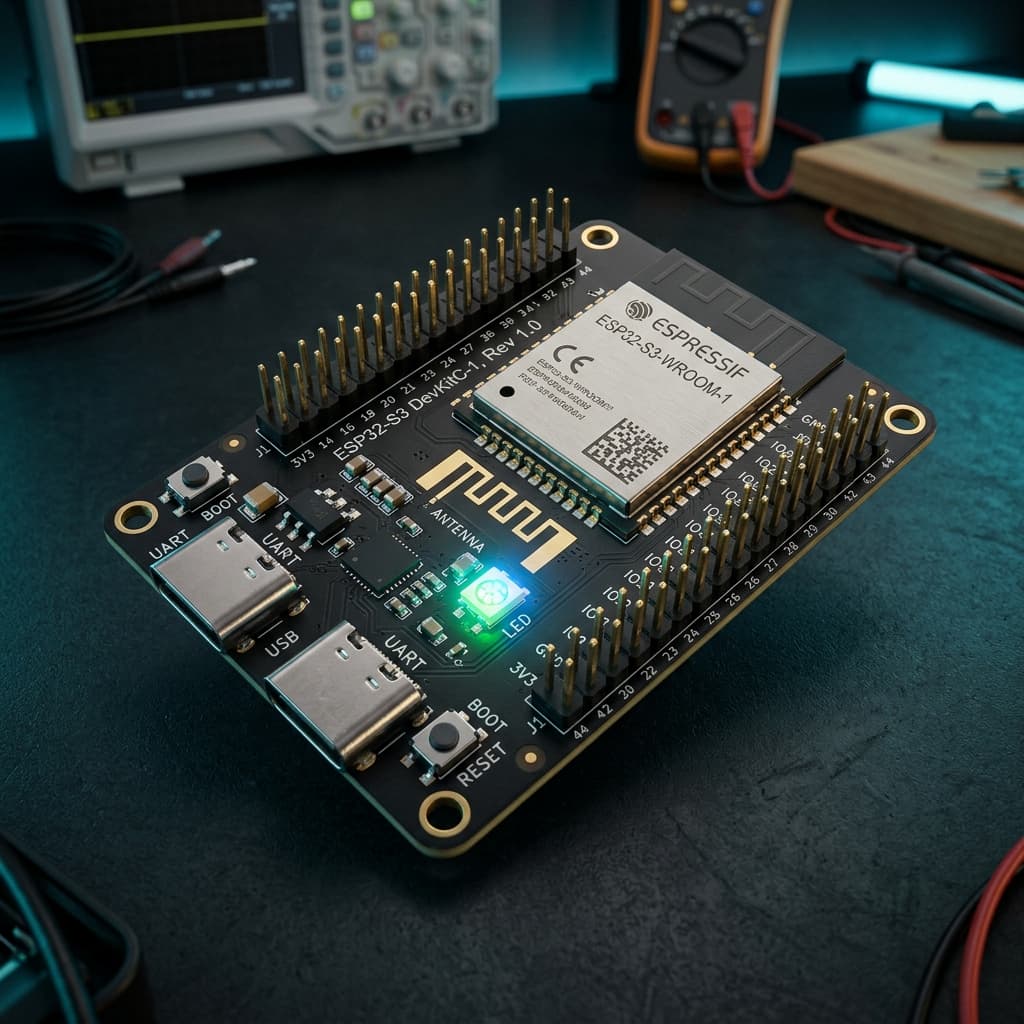
What is ESP32-S3 DevKit & Dual LX7?
The ESP32-S3 is Espressif’s flagship dual-core System-on-Chip engineered specifically for Edge AI, TinyML, voice recognition, and rich human-machine interfaces. Powered by dual 32-bit Xtensa LX7 processing cores running up to 240 MHz, it features dedicated vector instructions for accelerating convolutional neural networks and digital signal processing.
With 512 KB of internal SRAM, high-speed 8 MB Octal SPI Flash, up to 8 MB Octal PSRAM, native full-speed USB OTG alongside a dedicated UART Type-C port, and a hardware camera DVP interface, the ESP32-S3 bridges the gap between low-cost IoT endpoints and intelligent edge vision systems.
Technical Specifications
Recommended Applications & Industry Uses
Edge Computer Vision & Object Detection
Pair with OV2640/OV5640 camera sensors to run TinyML image classification and person detection models directly on-device.
Offline Voice Recognition & Wake-Word Detection
Use hardware vector instructions and dual I2S microphone inputs to execute neural network voice trigger recognition without cloud latency.
Smart Touchscreen GUI Terminals
Drive 800x480 RGB/SPI displays using LVGL with 8MB Octal PSRAM acting as a continuous double-buffered frame buffer.
Secure Industrial IoT Gateways
Hardware cryptographic accelerators (AES-XTS, RSA-3072, ECC) safeguard telemetry data transmitted over Wi-Fi and Bluetooth Mesh.
Key Features & Architectural Highlights
AI Vector Acceleration
240 MHz Dual LX7Includes hardware vector instructions that execute dot products and matrix operations in parallel, accelerating TinyML and neural network inferences by over 3x.
Native USB OTG + JTAG
Dual Type-C PortsFeatures both a hardware UART port and a direct native USB OTG port with built-in USB-JTAG debugging directly in VS Code and ESP-IDF without hardware probes.
Massive Memory Bus
8MB Octal PSRAMOctal SPI interface doubles memory bus bandwidth, effortlessly buffering full-color 800x480 LVGL touchscreen frames and camera video streams.
Camera & Display Interface
DVP Parallel BusIntegrated 8-bit to 16-bit DVP camera interface capable of capturing JPEG/RGB frames directly from OV2640 or OV5640 sensors with zero CPU overhead.
Long-Range Wireless
Wi-Fi 4 + BLE 5.0Supports 2.4 GHz Wi-Fi (802.11 b/g/n) and Bluetooth 5 (LE) with coded PHY for extended long-range transmission and Bluetooth Mesh networking.
Hardware Cryptography
RSA-3072 / AES-XTSIncludes secure boot based on RSA-3072, flash encryption using AES-XTS-256, HMAC, and a Digital Signature peripheral to safeguard intellectual property.
Pin Configuration & Peripheral Layout
Digital GPIO Matrix (45 Pins)
45 programmable GPIO pins with ultra-flexible IO MUX matrix operating at 3.3V logic.
- All output pins support hardware LEDC PWM up to 40 MHz with independent timers
- Direct connection to hardware SPI, I2S, I2C, and UART peripherals across any pins
- Strapping pins (GPIO 0, 45, 46) configure boot mode and internal LDO voltage
Analog & Capacitive Touch (ADC1 / ADC2)
Dual 12-bit SAR ADCs with up to 20 analog channels and 14 capacitive touch inputs.
- ADC1 (GPIO 1–10) functions reliably during active Wi-Fi data transfers
- ADC2 (GPIO 11–20) shared with wireless baseband; use ADC1 for precision telemetry
- 14 capacitive touch pins capable of detecting human touch through 10mm acrylic
Native USB, Camera & LCD Peripherals
High-speed dedicated silicon controllers for multimedia and direct bus communication.
- GPIO 19 (USB D-) and GPIO 20 (USB D+) connect directly to the native USB PHY
- Dedicated RGB/QSPI display controllers for fluid 60 FPS LVGL graphic user interfaces
- 3 independent hardware UART controllers and 2 I2C master/slave controllers
Communication Protocols
Native USB 2.0 FS
GPIO 19 (D-) & GPIO 20 (D+)
12 Mbps Full-Speed USB supporting CDC virtual serial, HID keyboard/mouse, MSC flash disk, and hardware JTAG debugging.
High-Speed SPI (FSPI/MSPI)
Octal SPI / Quad SPI
Up to 120 MHz bus speed for high-speed Octal Flash and Octal PSRAM streaming with DMA channels.
DVP Camera Interface
8-bit / 16-bit Parallel DVP
Connects to OV2640, OV3660, and OV5640 camera sensors with automatic DMA line buffering for real-time video.
I2S Audio & Voice
BCLK, WS, DOUT, DIN, MCLK
Dual I2S audio channels with PDM microphone decoding for wake-word speech detection and smart speakers.
Hardware UART (x3)
Dynamic IO MUX Mapping
3 fully independent UART controllers supporting baud rates up to 5 Mbps with automatic hardware flow control.
Two-Wire I2C (x2)
Default GPIO 8 (SDA) / 9 (SCL)
Dual I2C controllers supporting Standard (100 kHz), Fast (400 kHz), and Fast Plus (1 MHz) transmission modes.
Advanced Topics & Expert Knowledge
ESP-NN Vectorized TinyML
Use the ESP-NN acceleration library with TensorFlow Lite Micro to execute INT8 matrix multiplications using dedicated Xtensa PIE vector instructions.
Pro tip: Enables 15 FPS person detection models and sub-100ms offline voice keyword spotting directly on the chip.
Built-in USB-JTAG Debugging
Debug firmware line-by-line using OpenOCD and GDB over the native USB Type-C port without purchasing an external ST-LINK or J-Link probe.
Pro tip: Set breakpoints, inspect register values, and trace FreeRTOS stack usage directly in VS Code.
Octal PSRAM Memory Allocation
Allocate massive memory buffers using heap_caps_malloc() to hold uncompressed video frames and deep learning neural network weights.
Pro tip: Always allocate large display framebuffers in SPIRAM to keep internal SRAM free for DMA and Wi-Fi stacks.
Ultra-Low Power (ULP) Coprocessor
The integrated RISC-V ULP coprocessor monitors sensors and touch inputs while the dual 240 MHz main cores sleep in deep sleep at just 7 µA.
Pro tip: Wake up the main cores only when sensor readings exceed a defined analog threshold.
LVGL Fluid GUI Rendering
Drive parallel 16-bit RGB displays or SPI TFT displays at 60 FPS using the hardware RGB LCD peripheral and dual-framebuffer tearing prevention.
Pro tip: Combine LVGL 9 with ESP32-S3 DMA for smartphone-smooth scrolling menus and animations.
Hardware Secure Boot V2
Cryptographically sign all application firmware using an RSA-3072 private key; the hardware bootloader verifies signatures before execution.
Pro tip: Combine Secure Boot with Flash Encryption to prevent firmware reverse engineering and physical cloning.
Recommended Applications & Industry Uses
Edge Computer Vision & Object Detection
Pair with OV2640/OV5640 camera sensors to run TinyML image classification and person detection models directly on-device.
Offline Voice Recognition & Wake-Word Detection
Use hardware vector instructions and dual I2S microphone inputs to execute neural network voice trigger recognition without cloud latency.
Smart Touchscreen GUI Terminals
Drive 800x480 RGB/SPI displays using LVGL with 8MB Octal PSRAM acting as a continuous double-buffered frame buffer.
Secure Industrial IoT Gateways
Hardware cryptographic accelerators (AES-XTS, RSA-3072, ECC) safeguard telemetry data transmitted over Wi-Fi and Bluetooth Mesh.
Programming on ESP32-S3 DevKit & Dual LX7
📚 Official Citations & Technical References
To ensure the absolute accuracy and reliability of this guide, all specifications, pinouts, and register settings have been cross-verified with official manufacturer documentation:
Related Resources
Frequently Asked Questions
What are the main differences between the original ESP32 and ESP32-S3?
The ESP32-S3 upgrades to dual Xtensa LX7 cores with AI vector instructions, native USB OTG with on-chip JTAG, Octal SPI RAM/Flash support, Bluetooth 5.0 LE, and a camera DVP interface. Unlike the original ESP32, it does not include Bluetooth Classic (BR/EDR) or DAC outputs.
Why does the ESP32-S3 DevKit have two Type-C USB ports?
One port is labeled "UART" (connected to an onboard USB-to-UART chip for flashing and serial monitoring). The other is labeled "USB" (connected directly to the ESP32-S3 native USB PHY for USB-JTAG debugging, USB OTG host mode, and keyboard/mouse emulation).
Does the ESP32-S3 support TensorFlow Lite for Microcontrollers?
Yes! Espressif maintains the optimized ESP-NN library, which accelerates TensorFlow Lite Micro operators like depthwise convolution and fully connected layers using the LX7 vector instructions.