Choosing Your Silicon Core
Aspiring firmware developers and mechatronic systems engineers frequently grapple with platform choices. Starting with a classic **Arduino Uno** is standard educational practice, but professional deployment demands highly efficient, multi-threaded hardware with complex mathematical scaling. At this crossroad, developers either scale up to **ESP32** (connected IoT powerhouse) or **STM32** (industrial real-time standard).
Each platform caters to a specific domain:
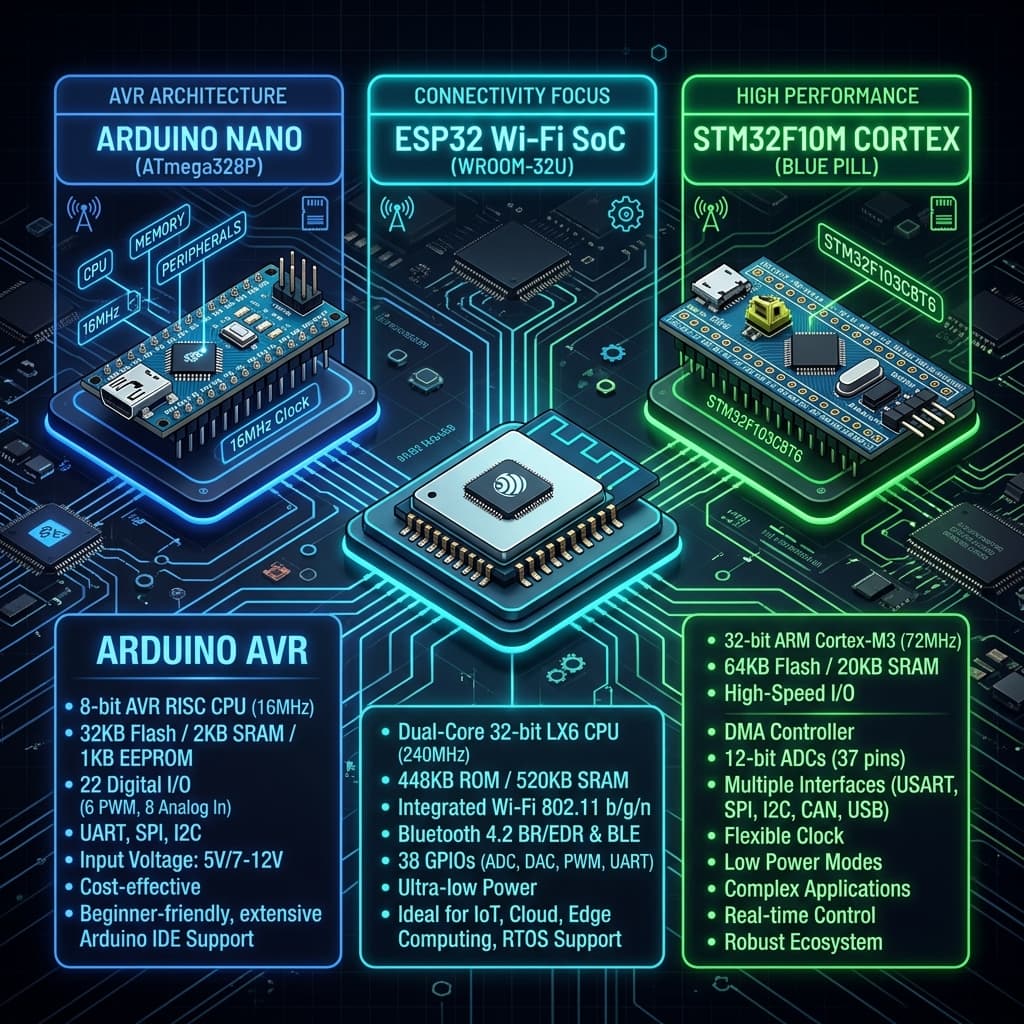
- Arduino (ATmega328P): The perfect, indestructible educational environment. With 8-bit AVR architecture and simple registers, it is ideal for rapid breadboard prototypes and basic low-frequency programming.
- ESP32 (Tensilica Xtensa): The king of connected IoT. Packing dual 32-bit cores running at 240 MHz, integrated Wi-Fi/BLE, and huge Flash layouts, it processes rich telemetry streams and runs native FreeRTOS out of the box.
- STM32 (ARM Cortex-M): The absolute industrial standard. Leveraging precise hardware clock matrices, multi-channel direct memory access (DMA), precise PWM encoders, and deep register debugging tools, it represents the gold standard for high-reliability medical, aerospace, and motor drive systems.
Performance & Hardware Limitations
Let\'s review the sheer mathematical limits. The 8-bit **Arduino** Uno features **32 KB of Flash** and only **2 KB of SRAM**. Running complex trigonometric filter equations or loading long strings will crash it immediately due to memory exhaustion.
The **ESP32** solves this with a massive **4 MB of external SPI Flash** and **520 KB of internal SRAM**. It processes float calculations in nanoseconds, hosts HTTP local servers, and handles secure HTTPS/TLS handshakes without breaks.
The **STM32** family scales from basic $1.00 cores (Cortex-M0) to premium chips (Cortex-H7 running at 480 MHz) with integrated hardware floating-point units (FPU). Its real strength lies in its **peripherals**: up to 3 separate 16-bit high-speed ADC converters, hardware encoder decoding timers, and high-speed industrial communication interfaces (CAN-FD, Ethernet).
Hardware Specifications Matrix
| Spec | Arduino Uno | ESP32 | STM32 (F401) |
|---|---|---|---|
| CPU Word Width | 8-bit | 32-bit | 32-bit with FPU |
| SRAM Size | 2 KB | 520 KB | 96 KB |
| Flash Size | 32 KB | 4 MB (up to 16MB) | 512 KB |
| Built-in RF | None | 2.4GHz Wi-Fi + Bluetooth | None |
Design and Platform Selection Mistakes
❌ Overkilling simple sensor nodes with an active ESP32
Deploying an ESP32 for a basic temperature reading node running on small AA batteries will drain them in days if Wi-Fi sleep states are not rigorously tuned. For pure, long-life, non-wireless sensor applications, a simple ultra-low power Arduino board or low-power STM32 MCU can operate on a single coin cell for several years.
❌ Expecting real-time motor control clock deterministic timing from ESP32 Wi-Fi threads
Because ESP32 runs Wi-Fi network stacks in high-priority threads inside its FreeRTOS kernel, those network updates can occasionally preempt user code, introducing timing jitter. High-speed vector FOC control loop algorithms should run on dedicated, non-preempted timers like those in STM32 or on the second core of ESP32 isolated from RF tasks.
Frequently Asked Questions
Can I write standard C/C++ code directly on STM32?
Yes. While beginners use Arduino frameworks on STM32 boards, industry engineers write professional C/C++ inside STM32CubeIDE using HAL (Hardware Abstraction Layer) APIs or by directly manipulating hardware registers to squeeze out maximum efficiency.
What is ESP-NOW?
ESP-NOW is a proprietary, low-power wireless protocol developed by Espressif that allows multiple ESP32 and ESP8266 devices to exchange short packets directly without connecting to a Wi-Fi router, minimizing power consumption.
Is there a professional debugger for Arduino?
Standard Arduino boards like the Uno lack hardware debugger interfaces (JTAG/SWD), limiting users to basic "serial printing". Professional boards like STM32 feature built-in ST-LINK debuggers, enabling developers to pause execution, step through line by line, and inspect internal registers in real-time.
Conclusion
Selecting microcontrollers is all about defining your product scope. Master the basic AVR logic in our Arduino learning center. Explore connected wireless networks with our ESP32 guides. Finally, scale your skills to professional standards by following the STM32 career roadmap!